NAME
golembot — Run Cursor, Claude Code, OpenCode, or Codex on Slack, Telegram, Discord, Feishu, DingTalk, WeCom — or embed into any…
SYNOPSIS
npm install -g golembotINFO
DESCRIPTION
Run Cursor, Claude Code, OpenCode, or Codex on Slack, Telegram, Discord, Feishu, DingTalk, WeCom — or embed into any Node.js product.
README







Your Coding Agent is trapped in a terminal. GolemBot sets it free.
 Compatible with 13,000+ OpenClaw community skills — the largest AI agent skill ecosystem. One command to search and install.
📖 Documentation & Guides → 0xranx.github.io/golembot
Cursor, Claude Code, OpenCode, Codex — these Coding Agents can already write code, run scripts, analyze data, and reason through complex tasks. But they're stuck in an IDE or a terminal window.
GolemBot gives them a body. One command connects your Coding Agent to Slack, Telegram, Discord, Feishu, DingTalk, WeCom, or any HTTP client. Write a custom adapter to plug in email, GitHub Issues, or any other message source. Or embed into your own product with 5 lines of code. No AI framework, no prompt engineering — the agent you already have is the brain.
Run Your Coding Agent Everywhere
On IM — your team's 24/7 AI teammate
golembot init -e claude-code -n my-bot
golembot gateway    # Slack, Telegram, Discord, Feishu, DingTalk, WeCom
Your colleagues @ the bot in group chat. It can write code, analyze files, answer questions — because behind it is a real Coding Agent, not a thin API wrapper.
In your product — full agent power, 5 lines of code
import { createAssistant } from 'golembot';
const bot = createAssistant({ dir: './my-agent' });
for await (const event of bot.chat('Analyze last month sales data')) {
if (event.type === 'text') process.stdout.write(event.content);
}
Embed into Slack bots, internal tools, SaaS products, customer support — anything that speaks Node.js.
Why GolemBot, not another AI framework?
| GolemBot | Traditional AI Frameworks | |
|---|---|---|
| AI brain | Cursor / Claude Code / OpenCode / Codex — battle-tested, full coding ability | You wire up LLM APIs + tools from scratch |
| Setup | golembot init → done | Chains, RAG, vector DB, prompt tuning... |
| Auto-upgrade | Agent gets smarter? Your assistant gets smarter. Zero code changes. | You maintain everything yourself |
| Transparency | ls the directory = see what the assistant knows and does | Black box pipelines |
| Engine lock-in | Change one line in config to swap engines | Rewrite everything |
| Skills | 13,000+ community skills from ClawHub, one command to install | Write your own tools and prompts from scratch |
Quick Start
npm install -g golembotmkdir my-bot && cd my-bot golembot onboard # guided setup (recommended)
Or manually:
golembot init -e claude-code -n my-bot golembot run # REPL conversation golembot gateway # start IM + HTTP service + Dashboard golembot fleet ls # list all running bots golembot skill search "data analysis" # browse 13,000+ ClawHub skills
Dashboard & Fleet
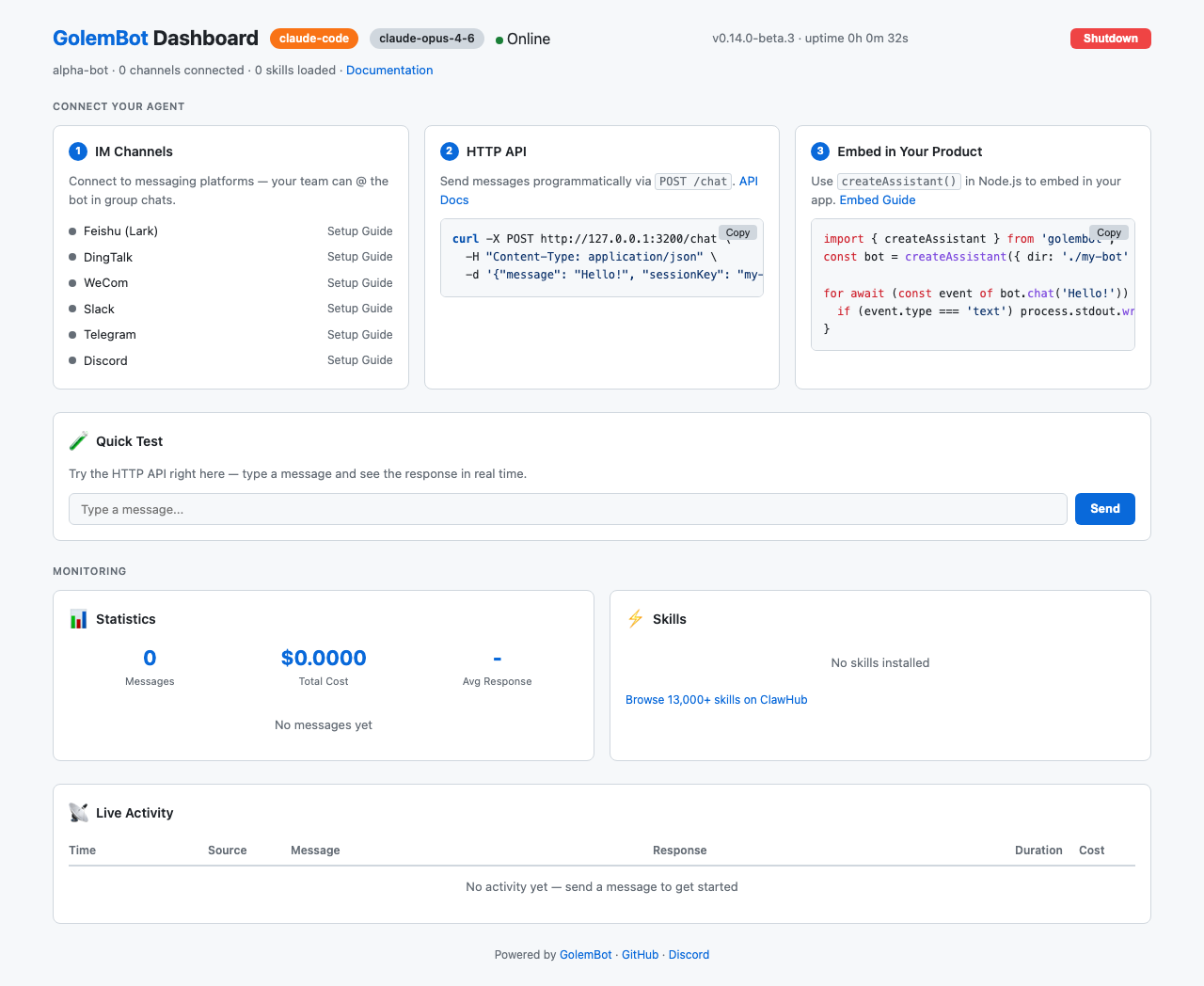
Every golembot gateway instance comes with a built-in web Dashboard showing real-time metrics, channel status, and a quick-test console:
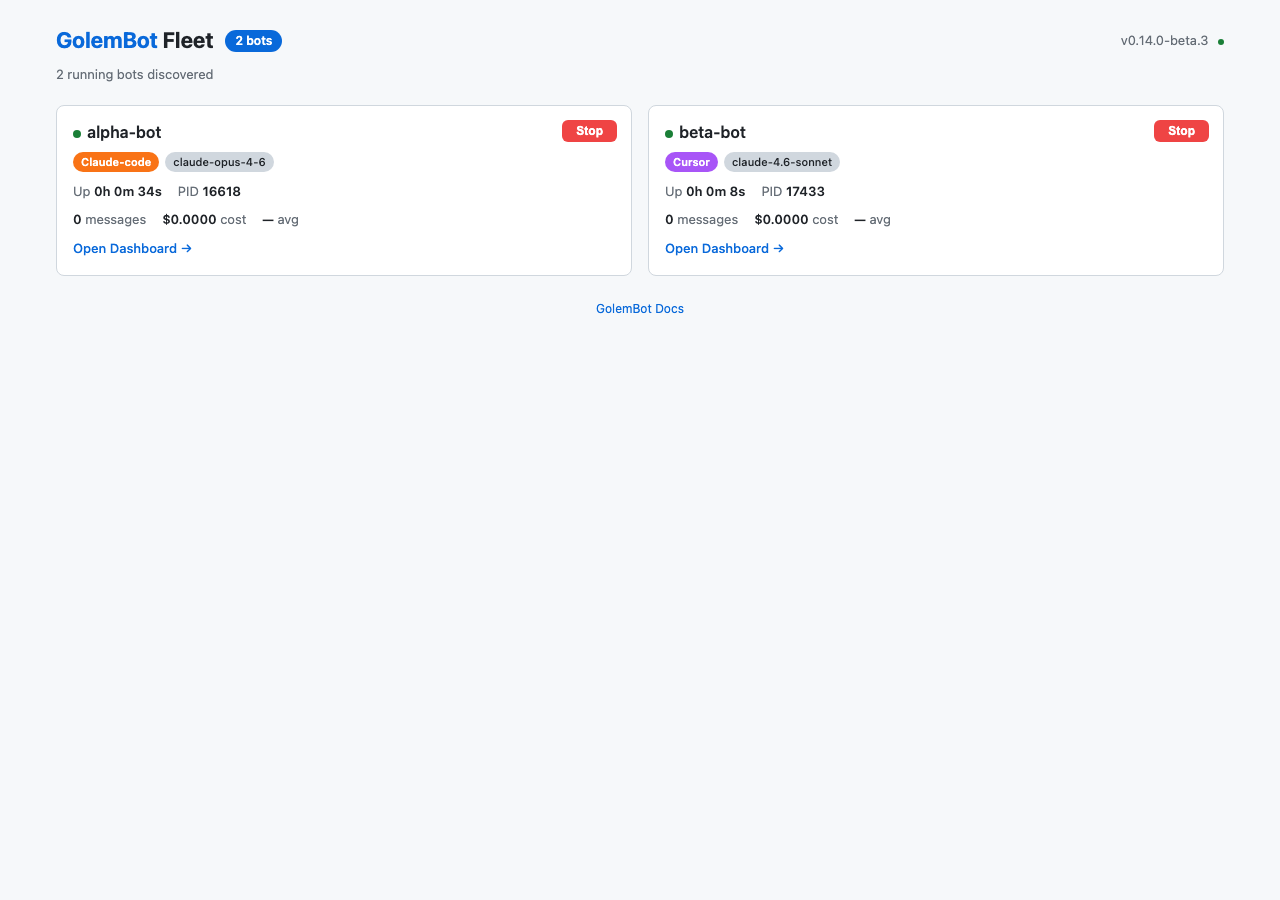
Running multiple bots? golembot fleet serve aggregates them into a single Fleet Dashboard:
Architecture
Slack / Telegram / Discord / Feishu / DingTalk / WeCom / HTTP API
    Custom Adapters (email, GitHub Issues, ...)
                    │
                    ▼
         ┌─────────────────────────┐
         │     Gateway Service     │
         │  (Channel adapters +    │
         │   HTTP service)         │
         └────────────┬────────────┘
                      │
              createAssistant()
                      │
          ┌───────┬───────┬───────┐
          ▼       ▼       ▼       ▼
       Cursor  Claude  OpenCode  Codex
               Code
Engine Comparison
| Cursor | Claude Code | OpenCode | Codex | |
|---|---|---|---|---|
| Skill Injection | .cursor/skills/ | .claude/skills/ + CLAUDE.md | .opencode/skills/ + opencode.json | AGENTS.md at workspace root |
| Session Resume | --resume | --resume | --session | exec resume <thread_id> |
| API Key | CURSOR_API_KEY | ANTHROPIC_API_KEY | Depends on Provider | OPENAI_API_KEY or ChatGPT OAuth |
The StreamEvent interface is identical across all engines — switching requires zero code changes.
Configuration
golem.yaml — the single config file:
name: my-assistant engine: claude-codechannels: slack: botToken: ${SLACK_BOT_TOKEN} appToken: ${SLACK_APP_TOKEN} telegram: botToken: ${TELEGRAM_BOT_TOKEN} discord: botToken: ${DISCORD_BOT_TOKEN} botName: my-assistant # optional — normalizes @mention tokens in channel messages feishu: appId: ${FEISHU_APP_ID} appSecret: ${FEISHU_APP_SECRET}
Custom adapter — local file or npm package
my-email: _adapter: ./adapters/email-adapter.js token: ${EMAIL_TOKEN}
gateway: port: 3000 token: ${GOLEM_TOKEN}
Sensitive fields support ${ENV_VAR} references. Custom channel adapters can be local .js/.mjs files or npm packages — see the adapter guide.
Skill System
A Skill is a directory containing SKILL.md + optional scripts. Drop it in, the assistant gains new abilities. Remove it, the ability is gone.
skills/
├── general/          # Built-in: general assistant
│   └── SKILL.md
├── im-adapter/       # Built-in: IM reply conventions
│   └── SKILL.md
└── my-custom-skill/  # Your own
    ├── SKILL.md
    └── analyze.py
ls skills/ is the complete list of what your assistant can do.
13,000+ Skills from ClawHub
GolemBot is fully compatible with ClawHub — the largest AI agent skill marketplace by OpenClaw. The SKILL.md format is 100% compatible, so all 13,000+ community skills work out of the box.
golembot skill search "data analysis"       # discover skills
golembot skill add clawhub:data-analysis    # one command to install
Agent-powered skill discovery: Your agent can search and install skills autonomously during conversations. Ask it "find me a good code review skill" — it searches ClawHub, shows results, and installs on your confirmation.
All skill commands support --json for programmatic access. The pluggable registry interface supports additional skill sources beyond ClawHub.
Docker Deployment
FROM node:22-slim
RUN npm install -g golembot
WORKDIR /assistant
COPY . .
EXPOSE 3000
CMD ["golembot", "gateway"]
Development
git clone https://github.com/0xranx/golembot.git
cd golembot
pnpm install
pnpm run build
pnpm run test          # Unit tests (1252+)
pnpm run e2e:opencode  # End-to-end tests (OpenCode)
pnpm run e2e:codex     # End-to-end tests (Codex)