NAME
jenkins-cli — Cross-platform CLI tool for triggering Jenkins builds. Written in Rust for high performance.
SYNOPSIS
cargo install jenkinsINFO
DESCRIPTION
Cross-platform CLI tool for triggering Jenkins builds. Written in Rust for high performance.
README
jenkins-cli
Cross-platform CLI tool for triggering Jenkins builds. Written in Rust for high performance.
Features
- Fast and efficient Jenkins job deployment
- Intuitive command-line interface with real-time console output
- Support for multiple Jenkins services, project filtering
- Common Jenkins operations support (e.g., triggering builds)
- High performance and cross-platform compatibility (Mac, Windows, Linux)
- Remembers last build parameters for quick re-runs
Demo

Installation
To install the Jenkins CLI tool, use one of the following methods:
bash <(curl -fsSL https://raw.githubusercontent.com/kairyou/jenkins-cli/main/scripts/install.sh)
Or use EdgeOne mirror (if GitHub is inaccessible)
bash <(curl -fsSL https://jenkins-cli.xhl.io/scripts/install.sh)
If you have Rust and Cargo installed, you can install Jenkins CLI directly from crates.io:
cargo install jenkins
Alternatively, you can download the binary file from the Releases page.
Usage
After setting up the configuration file (see Configuration section), you can simply run:
jenkins
This command will:
- Prompt you to select a Jenkins service (if multiple are configured)
- Display a list of available projects
- Select a project and set build parameters
- Trigger the build and show real-time console output
Ctrl+C behavior:
- During selection: go back to the previous step
- During queue/build: confirm whether to cancel
- Press twice quickly: force exit
You can also use command line arguments:
# Run with Jenkins project URL - Deploy project directly without selection jenkins -U http://jenkins.example.com:8081/job/My-Job/ -u username -t api_tokenRun with Jenkins server URL - Show project list for selection and deploy
jenkins -U http://jenkins.example.com:8081 -u username -t api_token
Run with Jenkins auth cookie (e.g. jwt_token) - Use only when API token is not accepted
jenkins -U http://jenkins.example.com:8081 --cookie "jwt_token=your-jwt"
Available command line options:
-U, --url <URL>: Jenkins server URL or project URL-u, --user <USER>: Jenkins username-t, --token <TOKEN>: Jenkins API token-c, --cookie <COOKIE>: Jenkins auth cookie (e.g. jwt_token=...)
Configuration
Create a file named .jenkins.toml in your home directory with the following content:
# $HOME/.jenkins.toml [config] # locale = "en-US" # (optional), default auto detect, e.g. zh-CN, en-US # enable_history = false # (optional), default true # check_update = false # (optional), default true # timeout = 30 # (optional), HTTP request timeout in seconds, default 30[[jenkins]] name = "SIT" url = "https://jenkins-sit.example.com" user = "your-username" token = "your-api-token"
includes = []
excludes = []
[[jenkins]]
name = "PROD"
url = "https://jenkins-prod.example.com"
user = "your-username"
token = "your-api-token"
includes = ["frontend", "backend"]
excludes = ["test"]
Configuration Options
config: Global configuration sectionlocale: Set language (optional), default auto detect, e.g. "zh-CN", "en-US"enable_history: Remember last build parameters (optional), default true, set to false to disablecheck_update: Automatically check for updates (optional), default true, set to false to disabletimeout: HTTP request timeout in seconds (optional), default 30
jenkins: Service configuration section (supports multiple services)name: Service name (e.g., "SIT", "UAT", "PROD")url: Jenkins server URLuser: Your Jenkins user IDtoken: Your Jenkins API tokenincludes: List of strings or regex patterns to include projects (optional)excludes: List of strings or regex patterns to exclude projects (optional)enable_history: Remember build parameters (optional), overrides global setting if specifiedcookie: Optional, Jenkins auth cookie (e.g. jwt_token=...). Sends a Cookie header when set.cookie_refresh: Optional, cookie auto-update configuration (updates thecookievalue)url: Refresh endpoint URLmethod: HTTP method, default "POST"request: Optional, request parameters (replaces${cookie.<name>}placeholders with values from thecookiefield):headers: Optional, extra request headers (for exampleX-Client-Id = "your-client-id")query: URL query parametersform: x-www-form-urlencoded body parametersjson: JSON body payload (supports string/number/boolean/object/array)
cookie_updates: Optional, cookie updates extracted from the response (written back to thecookiefield):body.json:<path>: JSON body path, e.g.body.json:data.refreshTokenheader:<name>: Response header name, e.g.header:X-JWT-Tokenbody.regex:<pattern>: Regex against response body, use capture group 1, e.g.body.regex:token=([\\w.-]+)
Cookie Authentication (Optional)
Most users should use user + token. Cookie auth is an optional fallback for setups that do not accept API tokens.
Note: If you have an extra endpoint to refresh cookie values, configure cookie_refresh to call it and write back to cookie; otherwise you can ignore cookie_refresh.
[[jenkins]] name = "Cookie-Refresh" url = "https://jenkins.example.com" cookie = "jwt_token=your-jwt"[jenkins.cookie_refresh] url = "https://auth.example.com/api/refresh-token" method = "POST"
Pick one request style:
request.query = { refreshToken = "${cookie.jwt_token}" } # send via query params
request.json = { refreshToken = "${cookie.jwt_token}" } # send via JSON body cookie_updates = { jwt_token = "body.json:data.refreshToken" }
Login API example (token returned in JSON body):
[[jenkins]] name = "Login-Refresh" url = "https://jenkins.example.com"[jenkins.cookie_refresh] url = "https://auth.example.com/api/auth/login" method = "POST"
Optional custom headers:
request.headers = { X-Client-Id = "your-client-id" }
request.json = { username = "your-username", password = "your-encrypted-password", remember = true } cookie_updates = { jwt_token = "body.json:data.token" }
Project Filtering
You can use includes or excludes to filter projects:
includes: ["frontend", "backend", "^api-"]# Include projects containing [frontend, backend, api-]excludes: ["test", "dev", ".*-deprecated$"]# Exclude projects containing [test, dev, *-deprecated]
Note: Regex patterns are case-sensitive unless specified otherwise (e.g., (?i) for case-insensitive matching).
Username and API Token
Your Jenkins username is typically the same as your login username for the Jenkins web interface.
To generate an API token:
- Log in to your Jenkins server
- Click on your name in the top right corner
- Click on
Configurein the left sidebar - In the
API Tokensection, clickAdd new Token - Give your token a name and click "Generate"
- Copy the generated token and paste it into your
.jenkins.tomlfile
Note: Keep your API token secure. Do not share it or commit it to version control.
TODOs
- Support multiple Jenkins services
- Support string and text parameter types
- Support choice parameter type
- Support boolean parameter type
- Support password parameter type
- Auto-detect current directory's git branch
- Remember last selected project and build parameters
- i18n support (fluent)
- Automatically check for updates
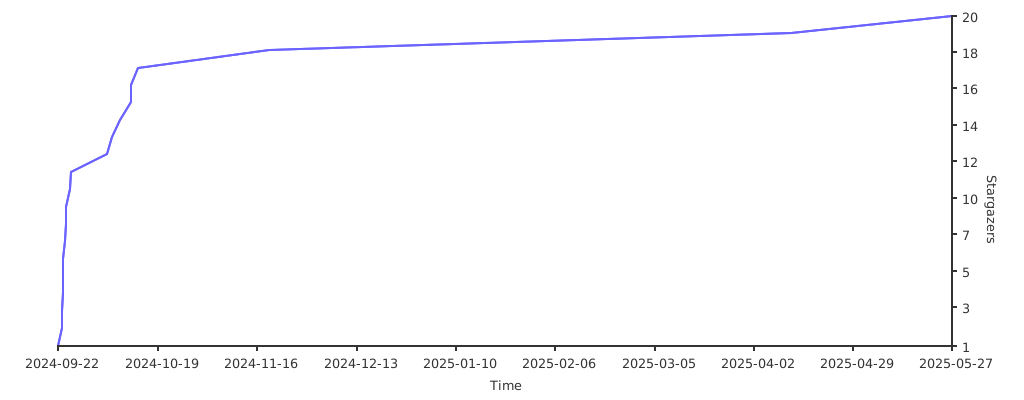
Stargazers over time
License
This project is licensed under the MIT License - see the LICENSE file for details.