NAME
ppu-paddle-ocr — Lightweight, probably the fastest PaddleOCR SDK in TypeScript. Runs anywhere JavaScript runs: Node.js, Bun, Deno, web…
SYNOPSIS
pip install onnxruntimeINFO
DESCRIPTION
Lightweight, probably the fastest PaddleOCR SDK in TypeScript. Runs anywhere JavaScript runs: Node.js, Bun, Deno, web browsers, and browser extensions. Docker-ready. The official SDK is browser-only.
README
ppu-paddle-ocr


Lightweight, probably the fastest PaddleOCR SDK in TypeScript. Runs anywhere JavaScript runs: Node.js, Bun, Deno, web browsers, and browser extensions. Docker & CLI supported. The official SDK is browser-only and significantly slower. Compare it for yourself.
Need it as HTTP-service? dockerized? we've got you covered! Quickly spins up ppu-paddle-ocr REST API here: ppu-paddle-ocr-serve. Need a CLI instead? sure here: ppu-paddle-ocr CLI support.
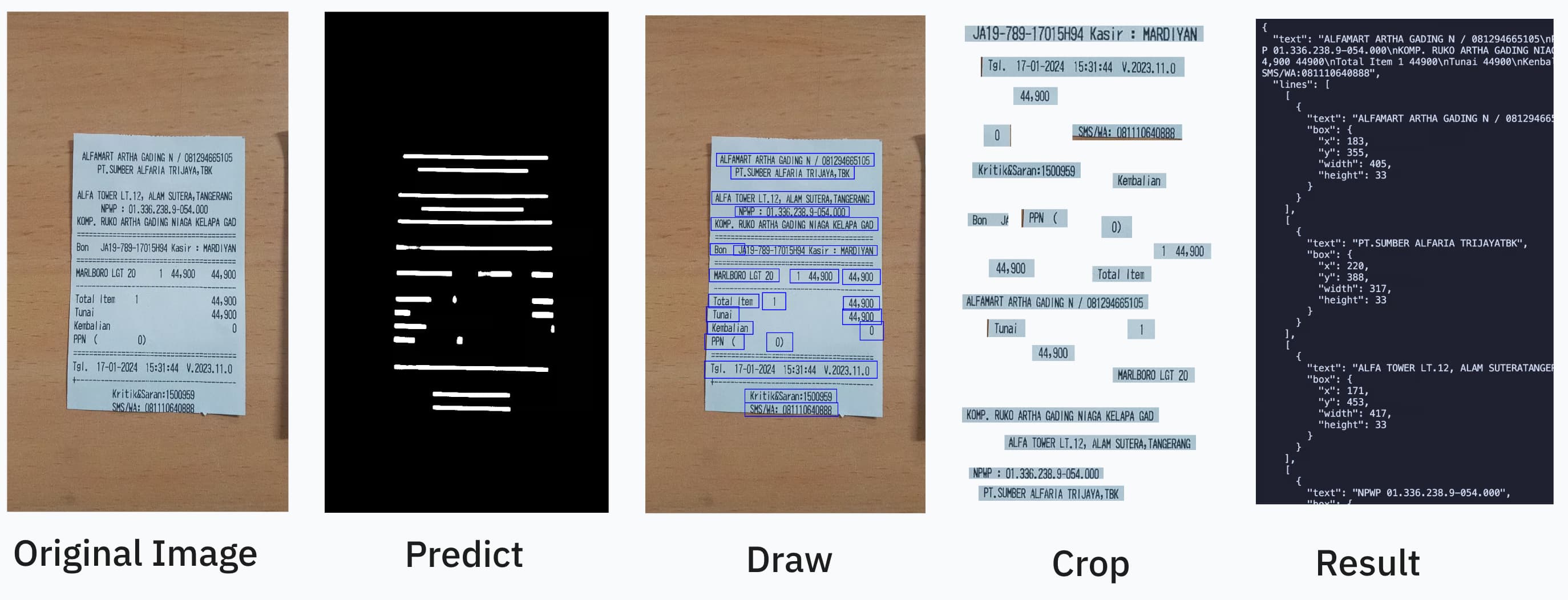
import { PaddleOcrService } from "ppu-paddle-ocr";const service = new PaddleOcrService(); await service.initialize();
const result = await service.recognize("./receipt.jpg"); console.log(result.text);
await service.destroy();
Table of Contents
- Quick Start
- Why ppu-paddle-ocr?
- Runtime Support
- Installation
- Core Usage
- Command Line
- Batch Recognition
- Recognition Strategies
- Image Preprocessing
- Processing Engine
- Web / Browser Support
- Models and Language Support
- Configuration Reference
- Benchmark
- Contributing
- License
- Support
- Scripts
Why ppu-paddle-ocr?
- Lightweight — minimal dependencies, optimized for performance.
- Pre-packed models — PP-OCRv5 mobile models (English) are fetched and cached automatically on first run. Supports 40+ languages via ppu-paddle-ocr-models.
- Runs everywhere — Node.js, Bun, Deno, web browsers, and browser extensions. The official SDK is browser-only.
- Customizable — custom models, dictionaries, and per-call overrides.
- TypeScript — full type definitions.
Runtime Support
The same package, the same API, every JavaScript runtime:
| Runtime | How to install | Try it |
|---|---|---|
| Node.js | npm install ppu-paddle-ocr onnxruntime-node | npm package |
| Bun | bun add ppu-paddle-ocr onnxruntime-node | npm package |
| Deno | deno add jsr:@snowfluke/ppu-paddle-ocr | JSR package |
| Web browser | npm install ppu-paddle-ocr onnxruntime-web (import /web subpath) | Live demo |
| Browser extension | Same as web; bundle ppu-paddle-ocr/web with your extension's bundler. | Example extension repo |
Installation
npm install ppu-paddle-ocr onnxruntime-node onnxruntime-web
Omit onnxruntime-node or onnxruntime-web depending on your target environment (Node/Bun vs browser).
Core Usage
Basic Recognition
import { PaddleOcrService } from "ppu-paddle-ocr";const service = new PaddleOcrService({ debugging: { debug: false, verbose: true, }, });
await service.initialize();
const result = await service.recognize("./assets/receipt.jpg"); console.log(result.text);
await service.destroy();
Custom Models
Pass file paths, URLs, or ArrayBuffers for the detection model, recognition model, and dictionary:
const service = new PaddleOcrService({
  model: {
    detection: "./models/custom-det.onnx",
    recognition: "https://example.com/models/custom-rec.onnx",
    charactersDictionary: customDictArrayBuffer,
  },
});
await service.initialize();
Changing Models at Runtime
const service = new PaddleOcrService();
await service.initialize();
await service.changeDetectionModel("./models/new-det.onnx");
await service.changeRecognitionModel("./models/new-rec.onnx");
await service.changeTextDictionary("./models/new-dict.txt");
Per-Call Options
Each recognize() call accepts RecognizeOptions for fine-grained control:
// Custom dictionary for one-off recognition const result = await service.recognize("./assets/receipt.jpg", { dictionary: "./models/new-dict.txt", });// Disable caching for fresh processing const fresh = await service.recognize("./assets/receipt.jpg", { noCache: true, });
// Combine options const result = await service.recognize("./assets/receipt.jpg", { noCache: true, flatten: true, strategy: "per-box", });
Command Line
The package ships a bin, so you can OCR without writing any code — bunx/npx resolve it directly (no global install):
# one image → recognized text on stdout bunx ppu-paddle-ocr recognize receipt.jpga URL, as structured JSON
npx ppu-paddle-ocr recognize https://example.com/invoice.png --json --pretty
many images (glob), fastest strategy, written to a file
bunx ppu-paddle-ocr batch "scans/*.png" --strategy cross-line --json -o results.json
print each result as it finishes
bunx ppu-paddle-ocr stream "scans/*.png"
pre-warm / clear the model cache, inspect the active config
bunx ppu-paddle-ocr download-models bunx ppu-paddle-ocr clear-cache bunx ppu-paddle-ocr models --json

Every PaddleOptions / RecognizeOptions field maps to a flag: --strategy, --engine, --flatten, --no-cache, --image-height, --model-detection/-recognition/-dict, detection tuning (--max-side-length, --padding-vertical, --padding-horizontal, --min-area, --mean, --std), --execution-providers, and for batch/stream --concurrency. Output is controlled by --json, --pretty, -o/--output, -q/--quiet, and --verbose.
Recognized text goes to stdout; progress and logs go to stderr, so output pipes cleanly. Exit codes: 0 success, 1 runtime error, 2 usage error. Run bunx ppu-paddle-ocr help for the full reference. The CLI uses the default v5 models unless you override the --model-* flags.
Batch Recognition
batchRecognize() runs recognize() over many images with bounded concurrency, so memory stays in check: at most concurrency images are decoded and in flight at once. Results are returned index-aligned to the inputs regardless of completion order.
const results = await service.batchRecognize([buf1, buf2, buf3]);
results.forEach((r, i) => console.log(i, r.text));
Concurrency defaults to "auto" — 1 when an accelerator provider (CUDA, WebGPU) is configured (a shared session serializes device work anyway, and parallel runs would stack VRAM), and a small CPU default otherwise to overlap JS preprocessing with native inference. Override it explicitly when you know your hardware:
await service.batchRecognize(images, { concurrency: 8, flatten: true });
Use settle: true to keep going when an image fails — each slot becomes { status, value | reason } instead of the call rejecting:
const results = await service.batchRecognize(images, { settle: true });
for (const r of results) {
  if (r.status === "fulfilled") console.log(r.value.text);
  else console.error("failed:", r.reason);
}
Track progress and cancel with the usual primitives:
const ac = new AbortController();
await service.batchRecognize(images, {
  signal: ac.signal,
  onProgress: (done, total) => console.log(`${done}/${total}`),
});
To consume results as they finish (and avoid buffering the whole batch), stream them — each item carries its input index for reordering:
for await (const item of service.batchRecognizeStream(images)) {
  if (item.status === "fulfilled") console.log(item.index, item.value.text);
}
batchRecognize / batchRecognizeStream also accept any Iterable or AsyncIterable of inputs, so a directory walk or queue never has to be materialized in memory at once. All RecognizeOptions (flatten, strategy, dictionary, noCache) are accepted and applied to every image. See BatchRecognizeOptions for the full surface.
Recognition Strategies
Recognition strategies control how detected text regions are cropped from the canvas and fed into the recognition model. Fewer inference calls means faster throughput.
| Strategy | Description |
|---|---|
per-box | Each detected box is recognized individually — n boxes, n inferences. |
per-line | Boxes on the same line are merged into a single crop — fewer inferences. |
cross-line | Crops are bin-packed across lines into uniform-width batches — fewest calls. |
Default: per-line (best accuracy/speed trade-off).
Strategies are set in RecognitionOptions:
const service = new PaddleOcrService({
  recognition: { strategy: "cross-line" },
});
await service.initialize();
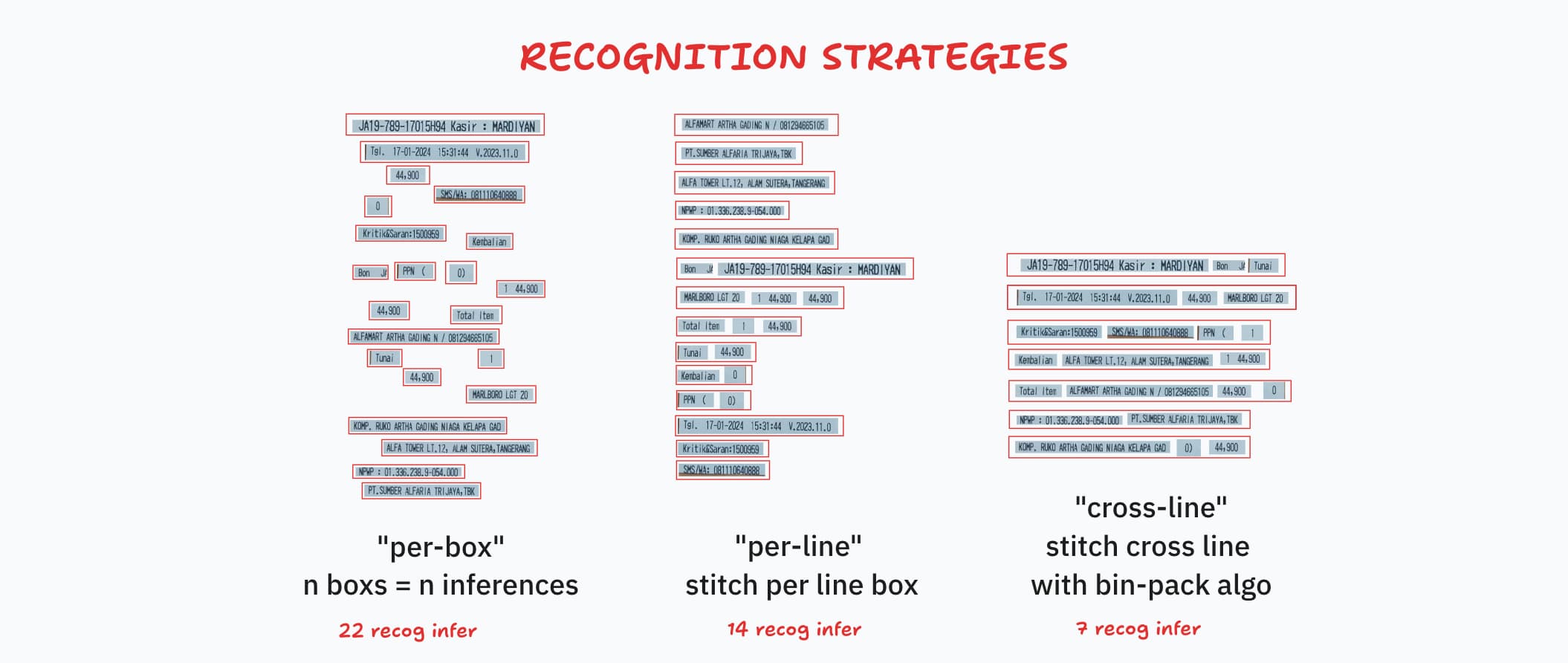
Image Preprocessing
PaddleOCR works best with grayscale or thresholded images. Use ppu-ocv for preprocessing before recognition:
import { ImageProcessor, CanvasProcessor } from "ppu-ocv"; const processor = new ImageProcessor(bodyCanvas);// For non-OpenCV environments (e.g. browser extensions) // const processor = new CanvasProcessor(bodyCanvas)
processor.grayscale().blur(); const canvas = processor.toCanvas(); processor.destroy();
Processing Engine
Two image processing backends are available for detection preprocessing and recognition resizing:
| Engine | Default | OpenCV Required | Notes |
|---|---|---|---|
"opencv" | Yes | Yes | Uses OpenCV.js from ppu-ocv. More accurate boxes. |
"canvas-native" | No | No | Pure canvas from ppu-ocv/canvas. Lighter weight. |
The browser build (ppu-paddle-ocr/web) always uses canvas-native — OpenCV.js is not bundled in the web entry point.
// OpenCV (default, recommended)
const service = new PaddleOcrService();
// Canvas-native (no OpenCV dependency)
const service = new PaddleOcrService({
processing: { engine: "canvas-native" },
});
Web / Browser Support
Import from ppu-paddle-ocr/web for browser-native capabilities (HTMLCanvasElement, OffscreenCanvas, fetch buffering).
Using a Bundler (Vite, Webpack, etc.)
import { PaddleOcrService } from "ppu-paddle-ocr/web";const service = new PaddleOcrService(); await service.initialize();
const file = document.getElementById("upload").files[0];
const img = new Image(); img.src = URL.createObjectURL(file); await new Promise((r) => (img.onload = r));
const canvas = document.createElement("canvas"); canvas.width = img.width; canvas.height = img.height; canvas.getContext("2d").drawImage(img, 0, 0);
const result = await service.recognize(canvas); console.log(result.text);
CDN (No Bundler)
See the live demo for a complete ESM/CDN setup.
WebGPU Acceleration
On WebGPU-capable browsers (Chrome/Edge on Windows/Linux/macOS, Firefox Nightly), ONNX inference automatically runs on the GPU — typically 2–5× faster with no code changes. The library silently falls back to WASM if WebGPU is unavailable or fails.
Detection runs once during initialize() and is fully transparent.
import { isWebGpuAvailable, getDefaultWebExecutionProviders } from "ppu-paddle-ocr/web";
if (await isWebGpuAvailable()) {
console.log("WebGPU supported");
}
Override Provider Preference
// Force WASM-only
const service = new PaddleOcrService({
  session: {
    executionProviders: ["wasm"],
    graphOptimizationLevel: "all",
  },
});
The WASM binaries are still required even when WebGPU is the primary provider (used for graph optimization and fallback ops). Set
ort.env.wasm.wasmPathsbeforeinitialize()if you self-host them.
Models and Language Support
Default Models
The default PP-OCRv5 mobile models are optimized for English and served in ONNX Runtime's .ort FlatBuffers format (3–5× faster session creation than .onnx):
| Component | File |
|---|---|
| Detection | PP-OCRv5_mobile_det_infer.ort |
| Recognition | en_PP-OCRv5_mobile_rec_infer.ort |
| Dictionary | ppocrv5_en_dict.txt |
Portable .onnx variants are available at ppu-paddle-ocr-models — point model.detection / model.recognition at the .onnx URLs.
Cache Location (Node / Bun)
Models are cached under ~/.cache/ppu-paddle-ocr:
| OS | Path |
|---|---|
| macOS | ~/.cache/ppu-paddle-ocr |
| Linux | ~/.cache/ppu-paddle-ocr |
| Windows | C:\Users\<username>\.cache\ppu-paddle-ocr |
// Warm the cache (e.g. in CI or Docker builds)
PaddleOcrService.downloadModels();
// Clear the cache
service.clearModelCache();
In the browser, model files are fetched via
fetch()on every page load and rely on the browser's HTTP cache. For persistent offline caching, use a Service Worker or store theArrayBufferin IndexedDB.
Multilingual Support
PP-OCRv5 supports 40+ languages across different script systems. Pre-converted ONNX models are available at ppu-paddle-ocr-models:
- Latin: English, French, German, Italian, Spanish, Portuguese, and 40+ others
- Cyrillic: Russian, Ukrainian, Bulgarian, Kazakh, Serbian, and 30+ related
- Arabic: Arabic, Persian, Urdu, Kurdish
- Indic: Hindi (Devanagari), Tamil, Telugu
- East Asian: Korean, Japanese
- Southeast Asian: Thai
Switching Languages
const MODEL_BASE = "https://media.githubusercontent.com/media/PT-Perkasa-Pilar-Utama/ppu-paddle-ocr-models/refs/heads/main"; const DICT_BASE = "https://raw.githubusercontent.com/PT-Perkasa-Pilar-Utama/ppu-paddle-ocr-models/refs/heads/main";
// Thai const service = new PaddleOcrService({ model: { detection:${MODEL_BASE}/detection/PP-OCRv5_mobile_det_infer.onnx, recognition:${MODEL_BASE}/recognition/multi/thai/v5/th_PP-OCRv5_mobile_rec_infer.onnx, charactersDictionary:${DICT_BASE}/recognition/multi/thai/v5/ppocrv5_th_dict.txt, }, });
Server Models (Higher Accuracy)
PP-OCRv5 is available in mobile and server variants:
const service = new PaddleOcrService({
  model: {
    detection: `${MODEL_BASE}/detection/PP-OCRv5_server_det_infer.onnx`,
    recognition: `${MODEL_BASE}/recognition/multi/en/v5/en_PP-OCRv5_server_rec_infer.onnx`,
    charactersDictionary: `${DICT_BASE}/recognition/multi/en/v5/ppocrv5_en_dict.txt`,
  },
});
INT8 Quantization
The recognition model's transformer MatMul operations can be dynamically quantized to INT8 with no accuracy loss (measured 99.22% → 99.22%) and a 20–50% speedup on x86-64 CPUs with VNNI and WebAssembly.
On Apple Silicon (M-series), INT8 is not faster — the FP32 NEON/Accelerate kernels outperform the INT8 MLAS path. Stick with FP32 on macOS ARM64.
Run the quantization helper:
pip install onnxruntime onnx sympy
python examples/quantize-onnx.py /path/to/en_PP-OCRv5_mobile_rec_infer.onnx
# -> produces en_PP-OCRv5_mobile_rec_infer_int8.onnx
Use the quantized model via model.recognition:
const service = new PaddleOcrService({
  model: {
    recognition: "https://example.com/en_PP-OCRv5_mobile_rec_infer_int8.onnx",
  },
});
INT8 .ort variants are also available in the ppu-paddle-ocr-models repo.
Model Output Limitations
- Tables: Text within table cells is detected, but table structure is not preserved.
- Math formulas: Not optimized for mathematical notation.
- Document layout: For layout detection, see PP-DocLayoutV2/V3 models in ppu-paddle-ocr-models.
Converting Custom PaddlePaddle Models
See the ONNX conversion guide.
Configuration Reference
PaddleOptions
import type { PaddleOptions } from "ppu-paddle-ocr";
export type PaddleOptions = {
model?: ModelPathOptions;
detection?: DetectionOptions;
recognition?: RecognitionOptions;
debugging?: DebuggingOptions;
session?: SessionOptions;
processing?: ProcessingOptions;
};
RecognizeOptions
Per-call options for recognize().
| Property | Type | Default | Description |
|---|---|---|---|
flatten | boolean | false | Return flat results instead of grouped by lines. |
strategy | "per-box" | "per-line" | "cross-line" | service default | Override strategy for this call. |
dictionary | string | ArrayBuffer | null | Custom character dictionary (disables caching). |
noCache | boolean | false | Bypass the result cache. |
BatchRecognizeOptions
Extends RecognizeOptions (applied to every image) for batchRecognize() / batchRecognizeStream().
| Property | Type | Default | Description |
|---|---|---|---|
concurrency | number | "auto" | "auto" | Max images in flight. "auto" = 1 on an accelerator provider, small default on CPU. |
settle | boolean | false | When true, a failed image yields { status: "rejected", reason } instead of throwing. |
signal | AbortSignal | null | Cancels the batch; pending images are not scheduled and the call rejects. |
onProgress | (done, total?) => void | null | Called after each image settles, with the running count and total (if known). |
ModelPathOptions
| Property | Type | Default / Required | Description |
|---|---|---|---|
detection | string | ArrayBuffer | Optional (uses default model) | Path, URL, or buffer for the detection model. |
recognition | string | ArrayBuffer | Optional (uses default model) | Path, URL, or buffer for the recognition model. |
charactersDictionary | string | ArrayBuffer | Optional (uses default English dictionary) | Path, URL, or buffer of the dictionary file. |
Leave a trailing newline in your dictionary file.
DetectionOptions
Controls preprocessing and filtering during text detection.
| Property | Type | Default | Description |
|---|---|---|---|
mean | [number, number, number] | [0.485, 0.456, 0.406] | Per-channel mean for input normalization [R, G, B]. |
stdDeviation | [number, number, number] | [0.229, 0.224, 0.225] | Per-channel std dev for input normalization. |
maxSideLength | number | 640 | Longest side limit (px); larger images are scaled down. |
paddingVertical | number | 0.4 | Fractional vertical padding per detected box. |
paddingHorizontal | number | 0.6 | Fractional horizontal padding per detected box. |
minimumAreaThreshold | number | 50 | Minimum box area (px²); smaller boxes are discarded. |
RecognitionOptions
Controls recognition preprocessing and strategy.
| Property | Type | Default | Description |
|---|---|---|---|
imageHeight | number | 48 | Fixed height for resized text line images (px). |
strategy | "per-box" | "per-line" | "cross-line" | "per-line" | Recognition strategy (see above). |
crossLineWidthFactor | number | 1.0 | Batch width multiplier for cross-line strategy. |
charactersDictionary | string[] | [] | Loaded character dictionary for result decoding. |
DebuggingOptions
| Property | Type | Default | Description |
|---|---|---|---|
verbose | boolean | false | Detailed console logs of each processing step. |
debug | boolean | false | Write intermediate image frames to disk. |
debugFolder | string | "out" | Output directory for debug images. |
SessionOptions
Any valid ONNX Runtime InferenceSession.SessionOptions property is accepted. ppu-paddle-ocr sets these defaults:
| Property | Type | Default | Description |
|---|---|---|---|
executionProviders | string[] | ExecutionProviderConfig[] | ['cpu'] | Execution providers for inference. Accepts strings or config objects. |
graphOptimizationLevel | 'disabled' | 'basic' | 'extended' | 'layout' | 'all' | 'all' | ONNX graph optimization level. |
enableCpuMemArena | boolean | true | Enable CPU memory arena for better memory management. |
enableMemPattern | boolean | true | Enable memory pattern optimization. |
executionMode | 'sequential' | 'parallel' | 'sequential' | Execution mode for the session. |
interOpNumThreads | number | 0 | Inter-op threads (0 = ONNX decides). |
intraOpNumThreads | number | 0 | Intra-op threads (0 = ONNX decides). |
const service = new PaddleOcrService({
  session: {
    executionProviders: ["cpu"],
    graphOptimizationLevel: "all",
    enableCpuMemArena: true,
    enableMemPattern: true,
    executionMode: "sequential",
  },
});
ProcessingOptions
| Property | Type | Default | Description |
|---|---|---|---|
engine | "opencv" | "canvas-native" | "opencv" | Image processing backend (see above). |
Benchmark
Benches use a small zero-dependency harness (bench/harness.ts): in-process timing, round-robin scheduling across rounds so thermal/GC drift hits every task equally, reporting the median plus min/max/stddev. Run bun task bench. Representative results on Apple M1 / Bun 1.3.14 (20 rounds, opencv + canvas-native):
task                                   median      ±stddev        min        max
--------------------------------------------------------------------------------
[per-box][opencv][noCache]             233.0 ms      14.6 ms   211.2 ms   254.5 ms
[per-line][opencv][noCache]            224.7 ms      17.6 ms   194.3 ms   256.0 ms
[cross-line][opencv][noCache]          213.9 ms      18.7 ms   194.7 ms   266.3 ms
[per-box][canvas-native][noCache]      242.3 ms      22.0 ms   213.3 ms   301.1 ms
[per-line][canvas-native][noCache]     224.3 ms      13.9 ms   201.9 ms   245.4 ms
[cross-line][canvas-native][noCache]   223.3 ms      14.4 ms   198.3 ms   248.6 ms
=== Accuracy on receipt.jpg (ground truth: 383 chars) ===
[opencv]       per-box=97.91%  per-line=99.22%  cross-line=96.34%
[canvas-native] per-box=97.65% per-line=98.43%  cross-line=97.65%
Absolute timings are thermal-sensitive on fanless hardware (Apple Silicon): sustained benching warms the chip and drags the median up, while the min column tracks the unthrottled per-call cost (~195 ms here). Treat these as relative, same-run comparisons, not cross-machine absolutes.
Batch vs. concurrent recognize()
bench/batch.bench.ts compares the ways to OCR many images, tracking peak RSS alongside time. Default models (v5), median over 7 rounds of 16 images each, Apple M1 / Bun 1.3.14, opencv, noCache:
task                          median      ±stddev        min        max   peak RSS
----------------------------------------------------------------------------------
sequential for-loop          3802.5 ms     300.6 ms  3169.4 ms  3979.7 ms    1059 MB
Promise.all(map(recognize))  3543.5 ms     254.0 ms  3030.0 ms  3768.0 ms    1428 MB
batchRecognize (auto)        3676.1 ms     200.9 ms  3217.1 ms  3761.3 ms    1096 MB
batchRecognize (c=4)         3653.8 ms     239.1 ms  3170.1 ms  3804.1 ms    1027 MB
batchRecognize (c=8)         3605.7 ms     187.6 ms  3202.1 ms  3786.6 ms    1096 MB
On CPU, throughput is bound by ONNX Runtime's native thread pool (which already saturates all cores per inference), so every parallel approach lands within ~4% on time — JS-level concurrency cannot add cores that are already busy. The real difference is memory: unbounded Promise.all peaks at ~1430 MB and grows with batch size, while batchRecognize stays bounded at ~1030–1100 MB regardless of N. So batchRecognize matches the fastest approach at lower, bounded peak memory — and the throughput win from concurrency shows up on GPU (overlapping host↔device) or I/O-bound inputs. Tune BATCH_N / ROUNDS via env.
Contributing
See CONTRIBUTING.md for setup instructions, code-quality requirements, and the pull request process.
License
MIT — see LICENSE.
Support
Open an issue or join our Slack community.
Scripts
Recommended development environment is Linux-based. Library template: https://github.com/aquapi/lib-template
| Script | Command | Description |
|---|---|---|
bun task build | bun run scripts/build.ts | Emit .js and .d.ts to lib/. |
bun task publish | bun run scripts/publish.ts | Stage package.json + README.md to lib/ and publish. |
bun task bench | bun run scripts/bench.ts | Run *.bench.ts files. |
bun task bench --node index | Run benchmark with Node.js for a specific file. |
To run a specific benchmark file:
bun task bench index     # Run bench/index.bench.ts
bun task bench --node    # Run all benchmarks with Node.js